
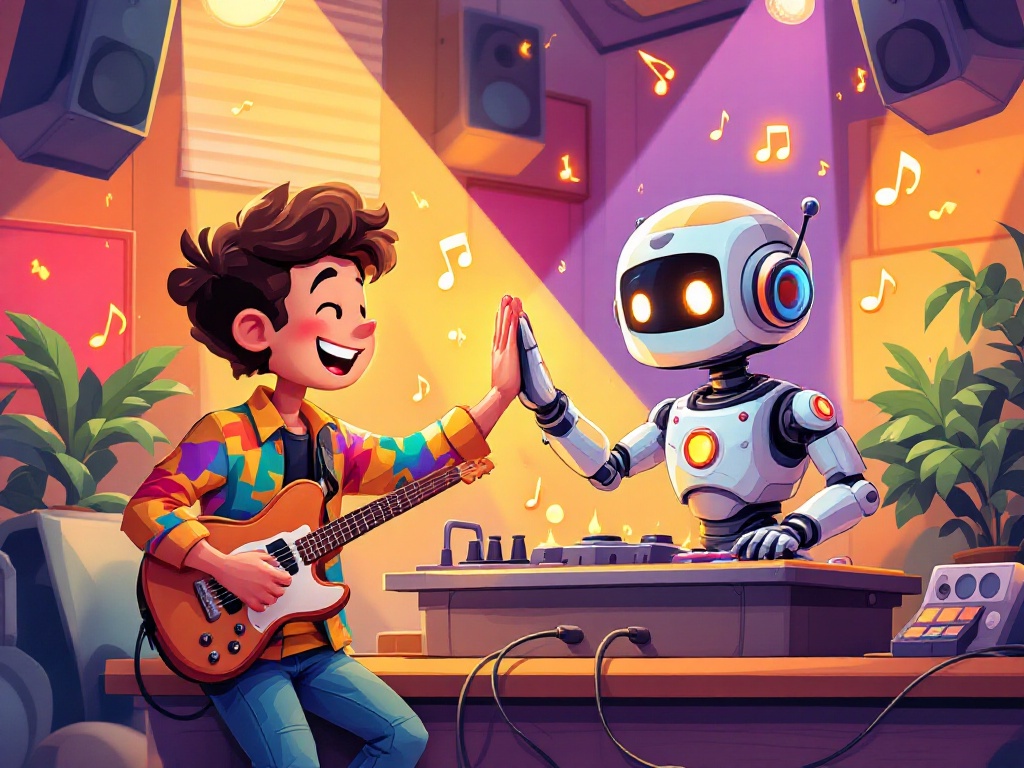
If you're losing sleep over robots taking your job, pour yourself a drink and let me break this down in terms that won't make your head spin.
Types of AI in Music: The Good, The Bad, and The Ugly
1. The Collaborators (The Good)
- Catalog Analysis AI: Think of it as your super-smart intern who can analyze millions of songs in seconds to tell you what's working and what isn't
- Distribution AI: Your 24/7 digital manager making sure your music hits the right playlists at the right time
- Audience Discovery AI: Your personal detective finding exactly who's vibing with your music
2. The Copycats (The Bad)
- Deepfake Voice AI: The sketchy cousin trying to clone artists' voices without permission
- Generic Music Generators: The assembly line of soulless tracks designed purely for algorithms
- Replacement AI: The tools marketed as "human replacements" rather than enhancement tools
3. The Game-Changers (The Beautiful)
- Hybrid Creation Tools: Where human creativity meets AI assistance
- Smart Production Assistants: AI that learns your style and helps you enhance it
- Data-Driven Decision Making: Using AI to make smarter career moves
Why Collaboration is the Only Way Forward
Here's the truth bomb: Fighting against AI is like trying to stop a tsunami with an umbrella. But here's the real kicker – you don't have to fight it at all. The future isn't about replacement; it's about enhancement.
Look at what we're doing at Hidden Pony with our Speaks Music platform. We're not trying to replace artists or managers; we're giving them superpowers. When you treat AI as a collaborator:
- Your creativity gets amplified, not replaced
- Your workflow becomes more efficient, not obsolete
- Your decisions become data-informed, not data-dictated
The Ethical Framework
The difference between ethical and unethical AI use comes down to three main principles:
1. Transparency: Being upfront about when and how AI is used
2. Attribution: Giving credit where it's due (both human and AI)
3. Enhancement vs. Replacement: Using AI to augment human creativity, not substitute it
Real Talk: The Bottom Line
The music industry isn't going to be taken over by robots. It's going to be led by smart humans who know how to collaborate with AI effectively. The question isn't whether to use AI – it's how to use it responsibly and effectively.
As Dave Brownsound from Sum 41 pointed out in the Token of Gratitude initiative, AI can be a force for good when it's focused on innovation and giving back to the community. It's not about replacing the human element; it's about enhancing what makes us uniquely human in the first place.