
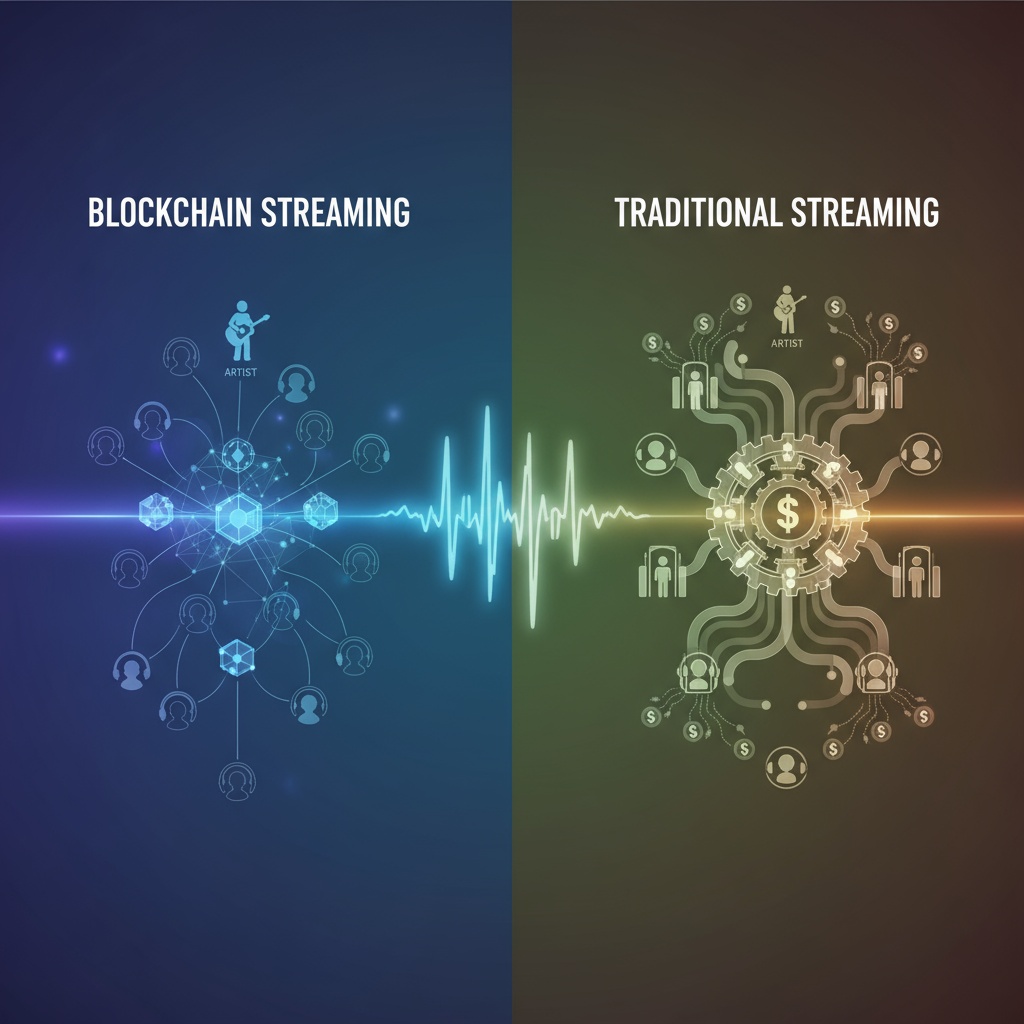
The music industry has always been about one thing: getting music from creators to listeners. But how we pay for that journey? That's where things get messy. Traditional streaming platforms have dominated for over a decade, but blockchain-based alternatives are emerging with bold promises. Let's cut through the hype and examine what's actually happening.
What Are Blockchain-Based Music Streaming Services?
Blockchain music platforms use distributed ledger technology to handle music distribution, payments, and rights management. Instead of a centralized company controlling everything, these platforms operate on decentralized networks where transactions are transparent, traceable, and theoretically fairer.
Think of it like this: traditional streaming is a nightclub with one bouncer controlling the door and the cash register. Blockchain streaming is more like a cooperative where everyone can see the books, and the money flows directly based on predetermined smart contracts.
Key players include:
Audius (decentralized streaming with artist tokens)
Emanate (real-time micropayments)
Opus (peer-to-peer music sharing)
Resonate (stream-to-own model)
Traditional Streaming: The Devil We Know
Spotify, Apple Music, Amazon Music, and YouTube Music have become the default way people consume music. They've solved distribution at scale, but they've created new problems.
The Traditional Model Pros:
Massive reach and discovery - Spotify alone has over 600 million users. That's exposure independent artists could never achieve on their own.
Professional infrastructure - Playlisting algorithms, curated editorial content, and sophisticated recommendation engines help listeners find new music.
Legitimacy and trust - Consumers trust these platforms. They're not downloading sketchy files or worrying about payment security.
Integration with the ecosystem - These platforms connect with social media, smart speakers, cars, and virtually every device. Convenience matters.
The Traditional Model Cons:
Abysmal per-stream rates - Artists earn between $0.003 and $0.005 per stream on Spotify. You need roughly 250,000 streams to make minimum wage for a month.
Opaque royalty systems - Payment structures are complex, delayed (often 3-6 months), and difficult to audit. Artists rarely understand exactly how they're being paid.
Power concentration - Major labels and distributors negotiate better rates, leaving independent artists at a disadvantage.
Algorithm dependency - Your career can live or die based on whether an algorithm decides to promote your track. There's little transparency in how these decisions are made.
Data ownership issues - Platforms own the relationship with your fans. They control the data, the communication channels, and ultimately, your audience access.
Blockchain Streaming: The Promised Land?
Blockchain advocates promise a revolution: direct artist-to-fan relationships, transparent payments, fair compensation, and artist empowerment. But does the reality match the rhetoric?
The Blockchain Model Pros:
Transparent royalty distribution - Smart contracts can show exactly how money flows from listener to artist. No more black box accounting.
Faster payments - Some platforms offer real-time or near-instant payments instead of quarterly statements arriving six months late.
Lower platform fees - Without massive corporate overhead, blockchain platforms can theoretically take smaller cuts (though this varies widely).
Artist ownership and control - Musicians retain more control over their work, pricing, and distribution terms.
Direct fan relationships - Artists can build tokenized communities, offer exclusive content, and create new revenue streams beyond streaming.
Immutable rights management - Blockchain creates permanent, transparent records of ownership and licensing, reducing disputes.
The Blockchain Model Cons:
Microscopic user bases - Even the largest blockchain platforms have user counts in the hundreds of thousands, not hundreds of millions. Exposure is severely limited.
Technical barriers - Many platforms require cryptocurrency wallets, token purchases, or blockchain knowledge that mainstream listeners don't have and don't want.
Sustainability questions - Some blockchain networks consume enormous energy (though newer proof-of-stake models are better). The environmental cost matters.
Volatility and speculation - Token-based economies can create financial instability. Your earnings might fluctuate wildly based on crypto market conditions.
Unproven business models - Many blockchain platforms are still experimental. Several have already shut down, taking artist content with them.
Regulatory uncertainty - Governments are still figuring out how to regulate crypto and blockchain. Legal risks remain unclear.
User experience gaps - Most blockchain platforms lag far behind traditional services in interface design, mobile apps, and overall usability.
The Real Talk: What This Means for Artists
Here's the uncomfortable truth: neither system is perfect, and the "best" choice depends entirely on your goals.
Choose traditional streaming if:
You need maximum exposure and discovery
You're building a mainstream audience
You want professional infrastructure and support
You're willing to trade lower per-stream rates for volume
Explore blockchain streaming if:
You have an engaged, tech-savvy fanbase
You want direct fan relationships and community building
You're comfortable with experimental platforms
You prioritize transparency and control over reach
The hybrid approach (my recommendation): Use traditional platforms for discovery and volume while experimenting with blockchain for superfans and direct monetization. Don't put all your eggs in one basket.
The Future: Convergence or Competition?
The most likely scenario isn't blockchain platforms replacing Spotify—it's traditional platforms adopting blockchain features. We're already seeing this with NFT integrations, artist tokens, and transparent royalty dashboards.
The real innovation isn't the technology itself; it's forcing the industry to reconsider how value flows from listeners to creators. Blockchain has exposed the problems with traditional streaming, even if it hasn't fully solved them yet.
Bottom Line
Blockchain-based music streaming offers genuine innovations in transparency, artist control, and payment speed. But it comes with significant tradeoffs in reach, usability, and stability.
Traditional streaming provides unmatched exposure and professional infrastructure but continues to undervalue artistic work and obscure how money moves.
The smartest artists aren't choosing sides—they're using both systems strategically, understanding that the future of music distribution will likely blend the best elements of each approach.
The question isn't whether blockchain will replace traditional streaming. It's whether blockchain will force traditional platforms to finally treat artists fairly. And on that front, the pressure is already working.
What's your take? Are you experimenting with blockchain platforms, or sticking with the traditional streaming grind? The conversation is just beginning.
#MusicStreaming #BlockchainMusic #MusicIndustry #IndependentArtist #MusicBusiness #ArtistEmpowerment #MusicTech #StreamingRoyalties #MusicInnovation #FutureOfMusic #MusicMarketing #IndieMusic #MusicDistribution #DIYMusician #ArtistDevelopment #MusicEntrepreneur #StreamingEconomy #Web3Music #MusicRights #FairPay #MusicProducer #IndependentMusic #MusicStrategy #CanadianMusic